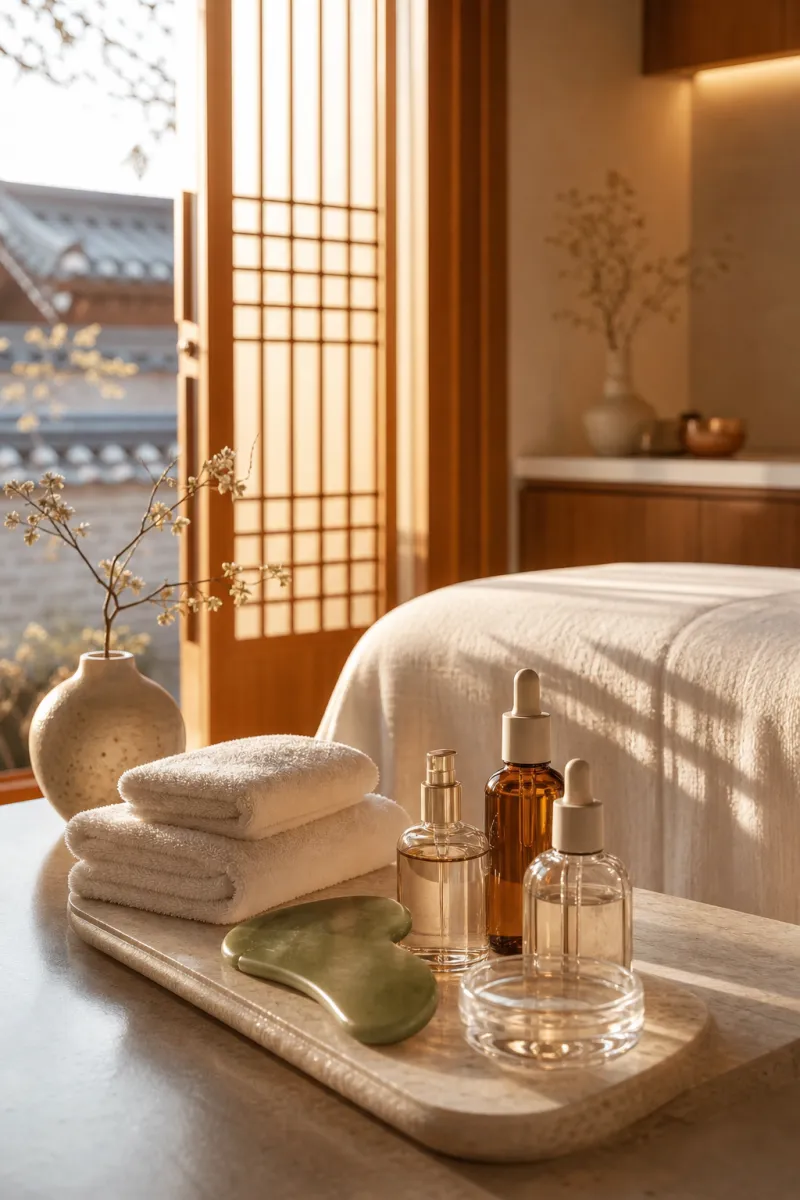
The best facial in Seoul for foreigners is usually a gentle one, booked after your skin has settled from the flight rather than on the day you land. Dry cabin air, short sleep, unfamiliar skincare and a climate that swings between humid summers and cold, dry winters can leave skin tight, flaky or prone to small breakouts for the first few days. A first facial that cleanses, hydrates and exfoliates lightly fits most visitors; acid peels, firm extraction and needle steps can wait. Below are the week-one changes to expect, a quick way to read your skin, and how to place a first session in the trip.
Guide
What the flight and a new climate do to skin in week one
Cabin air on long flights is very dry, and skin loses water through the surface for hours. Many travelers land with tight cheeks, flaking around the nose and makeup that sits unevenly. Jet lag adds poor sleep, and tired skin tends to sting more easily.
The season you arrive in matters too. Seoul summers are hot and humid, with a rainy spell, so oily and congested skin often feels worse. Winters are cold and dry outdoors, with strong indoor heating, which pulls moisture out of skin that was already thirsty. Spring can bring days of yellow dust and fine dust, when skin feels gritty by evening.
- Tight, flaky patches on the cheeks and around the nose
- Small closed bumps on the forehead or chin
- Stinging from products that felt fine at home
- Extra shine in humid weather
Guide
Reading your skin before you book
On your second or third morning, wash with a plain cleanser and wait about half an hour without applying anything. Then notice whether the skin feels tight, looks shiny, or stings under a basic moisturizer.
People who search for best facial in Seoul for foreigners reviews often find praise for strong peels and long extraction sessions. Someone else's result says little about how your skin will cope on day three of a trip, so let your own check guide the first booking.
| What you notice | What it suggests | First facial to consider |
|---|---|---|
| Tight and flaky | Dehydration from flight and heated air | Hydrating facial with a soothing mask |
| Shiny with small bumps | Congestion from humidity or new products | Gentle deep cleanse, light extraction only |
| Stings with plain moisturizer | Irritated barrier | Wait a few days or ask a doctor first |
| Red, itchy or swollen | Possible reaction or flare | Doctor assessment before any facial |
Guide
What a gentle first facial includes and leaves out
A sensible first session stays at the surface: a mild double cleanse, a soft enzyme or low-strength acid exfoliant, a hydrating ampoule, a calming mask and sunscreen. It should leave you a little pink at most and ready to walk around Hongdae that evening.
Leave medium-depth peels, firm extraction, microneedling and laser for a second visit. On jet-lagged skin they raise the chance of a reaction you would carry through the rest of your stay.
Guide
Where a light peel fits for acne or dark patches
Chen and colleagues, in a 2018 systematic review in BMJ Open, pooled 12 randomized trials with 387 participants on chemical peels for acne. Most head-to-head comparisons between peel agents showed no clear difference, and glycolic acid peels gave more improvement than placebo. The takeaway for a visitor: the acid's name matters less than a strength matched to how your skin is coping right now.
For melasma, Sarkar and Lakhani's 2024 systematic review in Dermatologic Surgery covered 24 studies with 1,075 participants and found chemical peels safe and effective, with glycolic acid the most strongly supported. Those studies ran 8 to 36 weeks, so one facial on holiday is not that course, and melasma darkens with sun.
Guide
Spacing your first facial within the trip
Give your skin two or three days after landing before the first session, and keep a few clear days between any light peel and your flight home so redness or flaking can settle while you are still nearby. If you plan two visits, put the gentle one first, and wear sunscreen and a hat in the days after any exfoliation.
Evidence
Research behind this page
- Chemical peels for acne vulgaris: a systematic review of randomised controlled trialsBMJ Open · 2018 · doi:10.1136/bmjopen-2017-019607
Systematic review of 12 randomized trials finding few clear differences between peel agents for acne, with glycolic acid peels improving acne more than placebo.
- Chemical Peels for Melasma: A Systematic ReviewDermatologic Surgery · 2024 · doi:10.1097/dss.0000000000004167
Systematic review of 24 studies concluding chemical peels are safe and effective for melasma, with glycolic acid the most strongly supported agent.
FAQ
Questions about Facials in Hongdae
What is the best facial treatment in Seoul for foreigners in the first days of a trip?
In the first days, a hydrating, gently cleansing facial without a strong peel suits most visitors. Skin is often dehydrated from the flight and adjusting to new air and products, so it reacts more easily than usual. A soft enzyme exfoliant and a soothing mask restore comfort without much risk. Save stronger peels or needle steps for a later visit, once you know how your skin is coping.
Why does my skin break out a few days after arriving in Seoul?
Breakouts after arrival usually come from a mix of dehydration, humidity, sleep loss and new skincare products tried all at once. Dry skin can respond by producing more oil, and heavy creams bought on a shopping trip can block pores. Go back to a simple routine for a few days. If the spots are deep, painful or spreading, see a doctor instead of booking extraction.
Should I bring my own moisturizer to the facial?
Bringing the moisturizer and sunscreen you trust is a good idea, especially if your skin is sensitive. You can ask the therapist to finish with your own products, or show them the label so they can avoid ingredients you know cause trouble. This lowers the number of new products touching your skin in one sitting. It also makes it easier to tell what caused any reaction afterward.
Does fine dust in spring change skin care after a facial?
Yes, on high fine dust days it helps to cleanse gently in the evening and keep freshly exfoliated skin covered with sunscreen and a moisturizer. Dust and pollution can make sensitive skin feel gritty and irritated. Avoid scrubbing to remove it, which damages the barrier further. Many visitors simply move a planned peel to a clearer day and keep the dusty day for a hydrating session.
Can I have a light peel if I take isotretinoin?
Generally no; peels are usually postponed while taking isotretinoin and for several months after stopping it. The drug thins the skin's protective layer and slows healing, so even a mild acid can cause unexpected irritation. Tell the staff about any acne tablets, retinoid creams or antibiotics before the facial. A hydrating session without acids is the usual alternative during treatment.
What if my skin is still tight a week after the facial?
Lasting tightness a week later usually means the barrier needs more support, not another treatment. Use a fragrance-free moisturizer twice a day, shorten hot showers and pause acids and scrubs. Indoor heating and dry outdoor air in winter can keep skin tight long after the facial itself. If tightness comes with burning, peeling patches or color change, show your skin to a doctor.