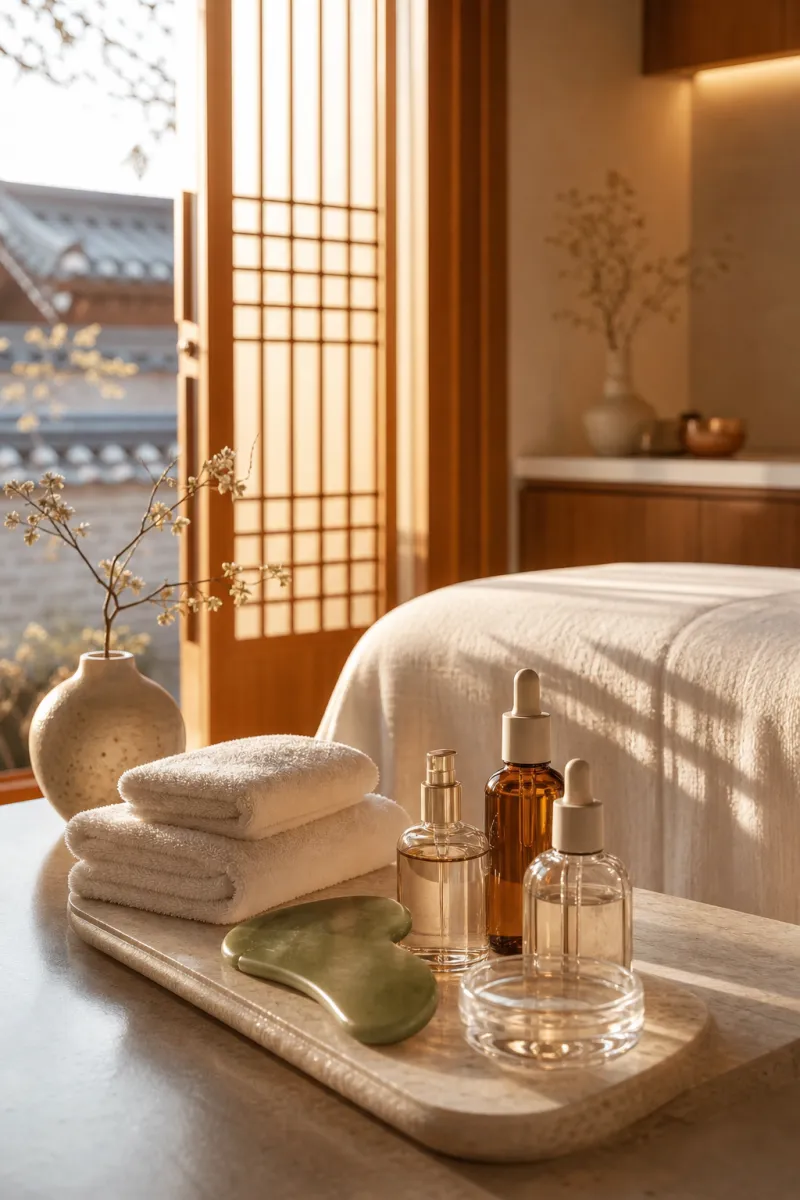
A Korea glass skin facial fits more naturally as one step inside a plan of four to eight weeks rather than as a single appointment expected to transform the face. One session of cleansing, gentle exfoliation and hydrating masks can leave skin looking clear and evenly lit, but that shine fades as water leaves the surface over the following days. A longer plan prepares the skin barrier at home first, places the facial or any clinic option at a sensible point, and keeps the result going afterward. Esthetic rooms offer cosmetic care only, while needles, lasers and medical peels belong in a clinic with a doctor. Results vary from person to person.
Guide
Why a single session rarely holds the look
The glass effect is light bouncing evenly off skin that is smooth, hydrated and calm. A facial improves hydration and smoothness for a short window, yet redness or uneven tone often return within a week if the daily routine stays the same.
A 2021 review by Humphrey and colleagues in Dermatologic Surgery offers a useful way to plan. The authors grouped skin quality into visible, mechanical and topographical attributes. Read as a checklist, it shows which part of the look a facial touches, mostly the visible layer, and which parts need weeks of consistent care or a medical treatment.
Guide
Weeks one to three: preparing the base at home
Most of the groundwork happens before any appointment. The aim is a calm, well-moisturized barrier so the session adds polish instead of irritation. Starting this at home also tells you how your skin reacts before you travel.
- Use a mild, low-foam cleanser twice a day and stop scrubbing with grains or brushes.
- Apply a broad-spectrum sunscreen every morning, including cloudy days.
- Add one humectant serum and one moisturizer, and keep them the same for three weeks.
- Do not start several new active products at once; patch-test anything new on the jaw first.
- If you use a retinoid or acid toner, ask the clinic how many days before the session to pause it.
Guide
A sample week-by-week schedule
The table below is a template, not a prescription. Someone with acne, rosacea or melasma should have a doctor adjust it, and anyone booking a glass skin facial in Korea during a short stay can compress the middle weeks into the days they are in Hongdae.
| Week | At home | Session option | What to watch |
|---|---|---|---|
| 1–3 | Gentle cleanser, sunscreen, steady moisturizer | None yet | Stinging, new breakouts, dry patches |
| 4 | Pause strong actives as advised | Cosmetic hydrating facial, or a clinic consultation | Redness lasting beyond the evening |
| 5–6 | Return to the base routine | A second facial, or a doctor-chosen light peel or booster | Tenderness, small bumps, flaking |
| 7–8 | Keep sunscreen and moisturizer daily | Review whether more sessions are worth it | Whether tone and texture still look even |
Guide
Where a device session fits, and what one study measured
Some menus add a handheld device step for glow and hydration. A 2024 prospective study by Ko and colleagues in the Journal of Musculoskeletal Science and Technology tested a high-intensity dynamic micro-massage device, which the authors describe as combining focused ultrasound and intradermal microwave features, in 21 healthy women. After one ten-minute session, instrument readings for elasticity, density, gloss and hydration were all higher than before treatment.
The design limits how far that goes. There was no control group, only one session, and measurements compared before and after the same visit, so the study cannot say how long the change lasted or how it compares with a plain hydrating mask. Treat a device step as an optional extra inside the plan, chosen with a doctor, not as the core of it.
Guide
Keeping the result after the flight home
The weeks after the trip decide whether the effect lasts. Keep the cleanser, moisturizer and sunscreen that worked during the plan, and avoid stacking new exfoliants the moment you land. Long flights dry the skin, so a simple moisturizing layer before boarding helps.
Write down what was done in each session, including product names and any device used. That record lets a clinic at home, or a return visit to Seoul, repeat the parts that suited you and skip what caused irritation.
Evidence
Research behind this page
- Defining Skin Quality: Clinical Relevance, Terminology, and AssessmentDermatologic Surgery · 2021 · doi:10.1097/dss.0000000000003079
A literature review proposing that skin quality be described through three categories of attributes: visible, mechanical and topographical.
- Impact of a High-Intensity Dynamic Micro-Massage (HIDM) Device on Facial Skin Elasticity, Skin Density, Glow, and Hydration: A Prospective StudyJournal of Musculoskeletal Science and Technology · 2024 · doi:10.29273/jmst.2024.8.2.125
In 21 healthy women, one ten-minute session with the device was followed by higher measured skin elasticity, density, gloss and hydration than at baseline, in a study without a control group.
FAQ
Questions about Facials in Hongdae
Can I follow a glass skin plan if I only have one week in Seoul?
Yes, if the home preparation starts before you fly and the trip covers only the session part of the plan. Begin the gentle cleanser, sunscreen and steady moisturizer about three weeks ahead. Book the facial early in the stay rather than the day before departure, so any redness settles while you are still nearby. Pack the same products so the routine continues without a break after you return.
How do I tell if a menu item is cosmetic care or a medical procedure?
Ask whether any step uses needles, injections, lasers or a medical-strength peel. Those steps are medical and are done in a clinic under a doctor. Cleansing, masks, gentle massage and cosmetic products are esthetic care, which can refresh the surface but does not treat a skin condition. A written list of steps before you pay removes the doubt.
Is a Seoul glass skin facial suitable for acne-prone skin?
It can be, provided active inflamed spots are treated or settled first and the products are chosen for oily skin. Rich oils and heavy creams can clog pores, so ask what will be applied. If breakouts are frequent, a doctor's assessment before the plan starts is more useful than a facial alone. Tell the therapist about any acne medication you take.
How often should a glass skin session be repeated?
Many people repeat a cosmetic facial every few weeks, while medical options follow the interval the treating doctor sets. Hydration gained in one session fades within days, so the home routine carries most of the effect between visits. Reassess at the end of the plan: if tone and texture stay even with home care alone, further sessions may add little.
Can an injected skin booster be part of the plan?
It can, but only as a medical treatment decided by a doctor after examining the skin. Boosters are placed with needles or injectors, so they carry bruising, small bumps and infection risk that a cosmetic facial does not. They usually sit in the middle weeks so swelling settles before photos or travel. Ask how many days of visible marks to expect before agreeing.
What should I bring home to keep the result?
Bring the cleanser, moisturizer and sunscreen that suited your skin during the plan, plus a written note of each session. Keeping products unchanged for a few weeks makes it easier to see what helps. Add new actives one at a time, at least a week apart, so a reaction can be traced to its cause and dropped quickly.