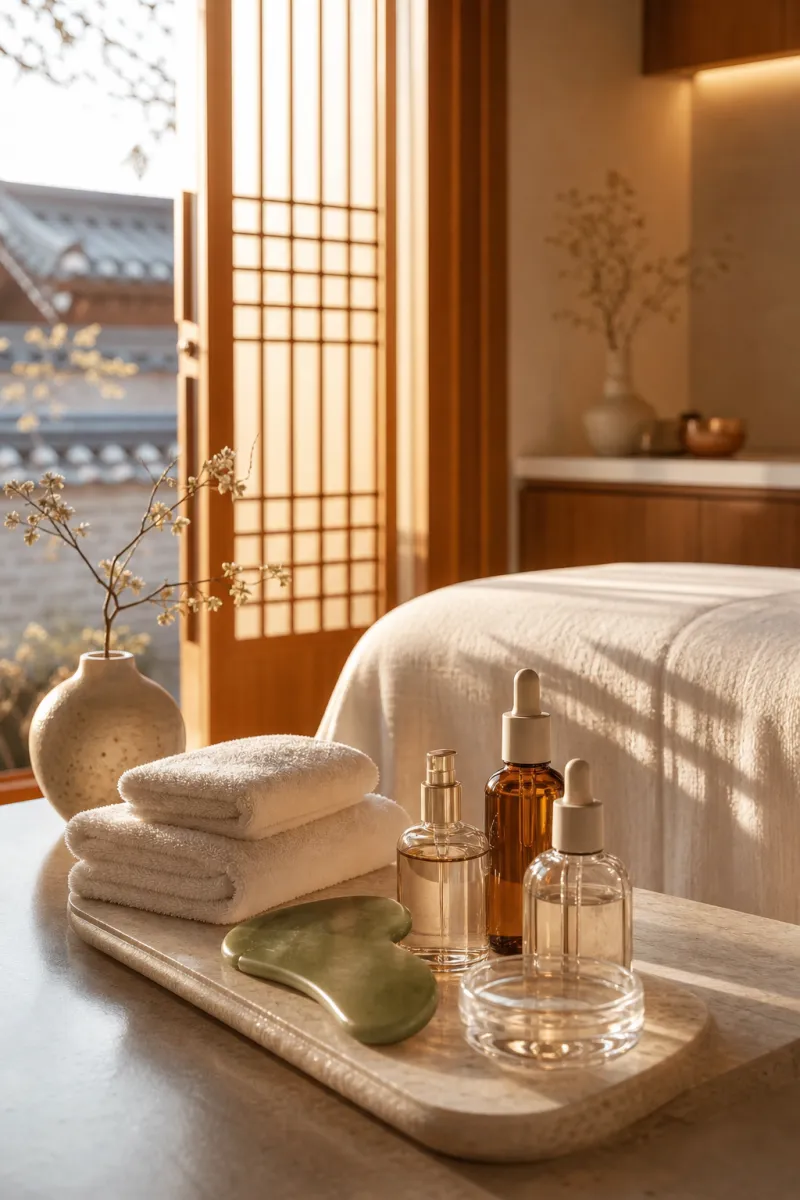
A foreigner-friendly facial in Seoul, for someone with sensitive or reactive skin, is one where staff will try products on a small patch first and show you the full ingredient list before anything covers the face. A reaction across the whole face can take days to settle, and those days may be the rest of your stay. A practical plan is a short consultation early in the trip, a trial of the acid, mask or serum on a hidden area, and the full facial once that spot stays calm. The sections below cover which products to test, how a test spot is read, how to share your reaction history and what two peel reviews say about acid strength.
Guide
Why a test spot matters more when you are only visiting
At home, a reaction to a new serum is an inconvenience you can watch for a week. In Seoul, it may arrive on the day you planned to walk around Hongdae, or peak after you have flown out. A test spot shrinks that risk to an area the size of a coin.
Reactive skin rarely reacts to the whole facial. It usually reacts to one ingredient: fragrance, a preservative, a plant extract in a sheet mask, a numbing cream or a peel acid. Testing separates those, so one product can be swapped instead of the session being cancelled.
Guide
Which products are worth trying on a small area first
Cleansers and plain water steps are rinsed off quickly. The steps that stay on the skin, or that are meant to provoke a mild response, are the ones to test.
- Peel solutions such as glycolic, lactic, salicylic or mandelic acid, above all before a first peel
- Sheet masks and ampoules that contain plant extracts, essential oils or added fragrance
- Topical numbing creams applied before needle or device steps
- Rubber or modeling masks that set on the face and are lifted off in one piece
- Any product type you have reacted to before, even under a different brand
Guide
How a test spot is done and read
For a leave-on product, a small amount goes on a hidden area, often along the jawline or just behind the ear, and is left alone. Irritation from strong actives tends to show within minutes to hours as stinging, heat or redness. A true allergy can take longer to appear, which is why formal allergy patch testing by a doctor is read after a couple of days rather than on the spot.
For an acid, the trial is shorter: a timed application on one small area, then neutralizing or rinsing, while staff watch for whitening, sharp burning or spreading redness. If the area is still red or itchy the next morning, the full-face peel should wait or move to a milder agent.
Guide
What peel reviews say about strength, contact time and skin type
In a 2008 review in Clinics in Dermatology, Landau groups chemical peels as superficial, medium or deep by how far the solution penetrates. The review notes that results depend on the chemical, its concentration, how it is applied, contact time, skin condition and preparation, and that depth shapes discomfort, healing time and the rate of side effects.
Sharad's 2013 review of glycolic acid peels in Clinical, Cosmetic and Investigational Dermatology adds that depth rises with concentration, the number of coats and how long the acid stays on, so one product can act as a very light or a medium-depth peel. The review describes it as well tolerated in Fitzpatrick skin types I to IV and stresses history, examination and neutralizing on time. For reactive or darker skin, ask which strength and contact time are planned before the step begins.
Guide
Sharing your reaction history in a form staff can use
Brand names change between countries, so a note naming a lotion from home is hard to act on in Seoul. Ingredient names travel better. Many cosmetics list ingredients by INCI name, an international naming system, so a word such as methylisothiazolinone or linalool can be checked against a label in the treatment room.
A short card is enough: known triggers by ingredient name, any eczema, rosacea or cold sore history, prescription creams or oral acne medicine, and the date of your last peel, laser or wax. Hand it over before the consultation.
Evidence
Research behind this page
- Chemical peelsClinics in Dermatology · 2008 · doi:10.1016/j.clindermatol.2007.09.012
A review that classifies chemical peels by penetration depth and explains how the chemical, concentration, application method, contact time and skin preparation shape results, healing time and side effects.
- Glycolic acid peel therapy – a current reviewClinical, Cosmetic and Investigational Dermatology · 2013 · doi:10.2147/ccid.s34029
A review of glycolic acid peels for acne, melasma, pigmentation and photoaging, noting that depth depends on concentration, number of coats and contact time and that careful history, examination and timely neutralization matter.
FAQ
Questions about Facials in Hongdae
Can a test spot and the full facial happen on the same day?
They can for a quick irritation check, but a next-day reading is safer if your skin has reacted before. Stinging or redness from an acid usually shows within minutes, so some rooms test and treat in one visit. A delayed allergic response can take a day or more to appear, and a same-day plan would miss it. Book the trial early in the trip and leave at least one night before the full session.
Is a korean facial in Seoul for foreigners gentler on sensitive skin?
Not automatically; how gentle a session feels depends on the products and steps chosen, not on the menu label. A layered routine with an acid, an ampoule and a sheet mask gives reactive skin several chances to flare in one hour. Ask which steps can be removed or swapped and whether a fragrance-free option exists. A shorter routine with fewer leave-on products is often easier to tolerate on a first visit.
Should fragrance be left out of a facial in Seoul for foreigners with reactive skin?
If fragrance has bothered your skin before, ask for it to be left out of every leave-on step. Fragrance blends and essential oils are well-known contact triggers, and they can hide inside masks, massage creams and toners rather than only perfumed products. Staff can usually point to an unscented alternative for most steps. Read the ingredient list yourself, since terms like parfum, linalool or limonene signal added scent.
What does it mean if the test area itches the next day?
Itching that starts hours later points toward an allergic response rather than simple irritation, so that product should stay off your face. Delayed reactions often look like small bumps or a patch of dry, red skin limited to where the product sat. See a doctor if the itch spreads, blisters or swells beyond the area. Ask staff to write down the product name and ingredient list so you can avoid it later.
Is a test spot by facial staff the same as an allergy patch test?
No; a test spot checks how your skin handles one product, while an allergy patch test screens many standard allergens and is read by a doctor. Patch test panels are taped onto the back and checked over several days, which rarely fits a short trip. If you get repeated rashes from skincare, formal testing at home before travelling gives you a precise list of ingredients to avoid in Seoul.